
Why America Couldn’t Hear Marianne Williamson
When fear called love unserious

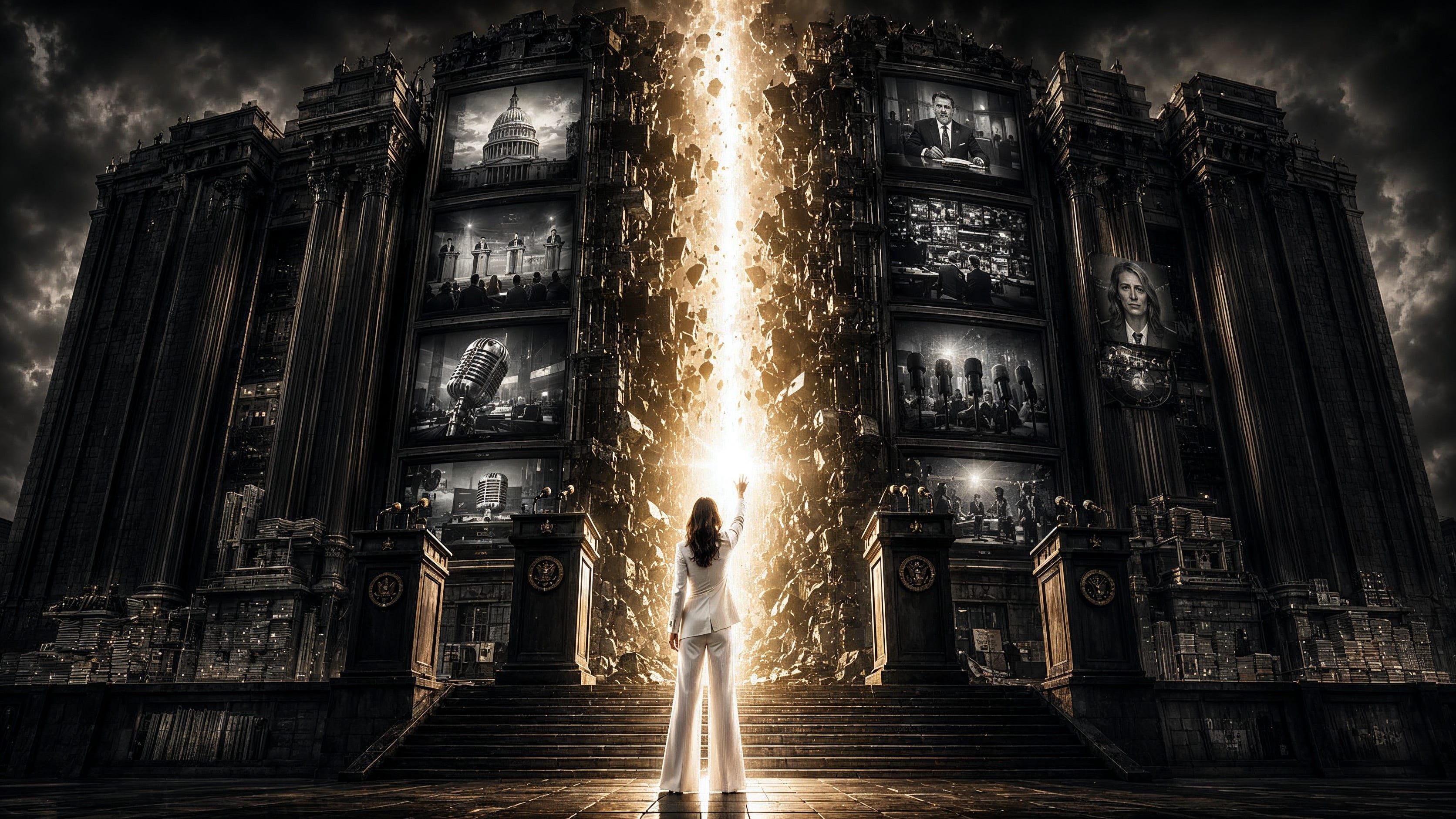
Update: I’ve now published the follow-up: Marianne Williamson’s Politics of Love Has Nothing to Do With Feelings.
This piece explains why America couldn’t hear Marianne. The follow-up goes deeper into what she actually meant by love as a political standard.
Read this with AI
Want a faster way in? Open the copy-ready page and use the AI guide.
In the waning light of empire, sincerity is rebellion.
In 2019, Marianne Williamson stood on a Democratic debate stage and said something that should have stopped the country cold. Speaking to Donald Trump, she said, “You have harnessed fear for political purposes, and only love can cast that out… I’m going to harness love for political purposes. I will meet you on that field, and sir, love will win.”
Much of the political-media world laughed.
Cable news smirked. The internet memed. The caricature hardened: orb lady, crystal lady, woo-woo, not serious. The moment became a joke before it could become a question.
But years later, after watching her campaigns, listening to her speak, reading her political books, and seeing how people reacted to her, another possibility becomes harder to ignore:
Maybe Marianne Williamson’s campaigns were not merely failed campaigns.
Maybe they were diagnostic events.
Maybe they revealed something America badly needed to see about itself.
Because the strangest thing about Williamson’s presence in American politics was never that she talked about love. It was how aggressively the political-media system needed to make that love look ridiculous.
The accusation was always some version of the same thing:
She was unserious.
But if you actually read Healing the Soul of America and A Politics of Love, the accusation collapses. These are not vague books. They are not clouds of pleasant spiritual sentiment floating above the real world. They are books about war, poverty, children, trauma, racism, reparations, corporate power, immigration, greed, civic responsibility, moral repair, and the unfinished promise of American democracy.
Real seriousness is not the ability to sound hardened, cynical, or institutionally approved. Real seriousness is the willingness to face what is actually happening and ask what truth, love, and responsibility require.
So the question is not simply: why did people dismiss Marianne Williamson?
The deeper question is:
What kind of society hears a call for atonement, peace-building, child protection, racial repair, economic justice, immigrant dignity, and love as public power — and calls it unserious?
That is where the mirror begins.
The System Had No Category for Her
By “the system,” I do not mean one secret room or a single conspiracy. I mean the overlapping machinery of media incentives, party gatekeeping, donor logic, platform algorithms, pundit culture, and public cynicism that determines what is allowed to appear serious.
That machinery did not know what to do with Williamson.
So it reduced her.
The public frame around her often had less to do with her platform than with her persona. “Crystal lady” became easier than reparations. “Woo-woo” became easier than a Department of Peace. “Long-shot” became easier than asking why the Democratic primary system had so little room for actual debate. “Not viable” became easier than asking who gets to manufacture viability in the first place.
The word “love” became the trapdoor. Once she said it, many people stopped hearing the rest.
That is one of the great tragedies of her public reception. The word that was supposed to open the conversation became the word used to close it.
In American politics, love is allowed to exist as a private feeling, a campaign slogan, a religious decoration, a Hallmark virtue, or something a president says after a tragedy before returning to business as usual.
But love as policy? Love as power? Love as foreign policy? Love as economics? Love as racial repair? Love as national security? Love as the bottom line?
That is where the system recoils.
Williamson was not saying love should replace policy. She was saying love should become the consciousness from which policy is made.
That is a very different claim.
And it is not soft.
This is not an argument for theocracy. Williamson’s politics are not about imposing religion through the state. They are about asking whether democratic life can be guided by moral principles almost every wisdom tradition recognizes: truth, mercy, justice, humility, repair, and care for the vulnerable.
Love Was Not the Soft Part
The great mistake is thinking love was the soft part of Marianne Williamson’s politics.
It was the hard part.
Love is easy when it means being pleasant to people who already agree with you. It is much harder when it means telling the truth about slavery, genocide, racism, war, poverty, addiction, greed, and democratic failure.
It is harder when it means reparations. Harder when it means forgiving without denying harm. Harder when it means protecting children who are not yours. Harder when it means welcoming the stranger you were taught to fear. Harder when it means telling a nation that its economy is morally disordered. Harder when it means asking citizens to stop spectating and participate. Harder when it means saying peace must be built as seriously as war. Harder when it means giving up contempt. Harder when it means admitting the system is not merely broken, but breaking people.
In Williamson’s framework, love does not mean politeness. It does not mean conflict avoidance. It does not mean pretending injustice does not exist.
Love means telling the truth. Love means repairing harm. Love means protecting children. Love means feeding people. Love means facing history. Love means refusing to scapegoat immigrants. Love means building peace instead of merely funding war. Love means recognizing that democracy is not just a system of rights, but a sacred field of responsibility.
Love, in Williamson’s politics, is not the opposite of seriousness.
Love is what seriousness looks like when it remembers life.
But America has been trained to hear the word differently. In a culture ruled by money, love sounds naïve. In a politics ruled by fear, love sounds weak. In a media system ruled by spectacle, love sounds boring. In a nation addicted to conflict, love sounds like withdrawal.
And that may be the point.
American politics has become addicted to the high of drama. Trump is the most obvious expression of that addiction, but the addiction is broader than Trump. The media feeds it. The public metabolizes it. The parties exploit it. The platforms monetize it.
Marianne Williamson’s politics, by contrast, often felt like sobriety.
Clarifying. Uncomfortable. Hard to enjoy if you are still attached to the high.
Fear Is to Love as Darkness Is to Light
One of Williamson’s core spiritual teachings is that fear is to love as darkness is to light.
Darkness is not a substance equal to light. It is the absence of light. Fear is not a force equal to love. It is the absence of love.
This is not just a comforting metaphysical idea. It is a political key.
Darkness, here, does not mean evil people. It means unconsciousness. It means fear, denial, greed, cruelty, and the absence of love operating inside people and institutions.
Williamson is not the light itself. She is one person who insisted on pointing toward it.
If fear is darkness, then a system organized around fear will not experience love as a gentle improvement. It will experience love as exposure.
Light does not negotiate with darkness. It reveals what darkness hides.
That is why love can feel threatening. Not because love attacks, but because love illuminates. It exposes what has been normalized. It reveals what has been hidden. It shows the wound under the performance. It names the absence.
A politics of love walks into a fear-based system and suddenly the system has to explain itself.
Why are children hungry in the richest country in the world? Why is war always funded and peace always treated as extra? Why are corporations treated as more real than human beings? Why is poverty framed as personal failure while greed is framed as success? Why is racial repair considered radical, but racial denial considered moderation? Why is immigrant suffering politically useful? Why is cynicism mistaken for intelligence? Why is spiritual emptiness called realism?
This is why a fear-based system will always call love unrealistic.
Because love is the end of its reality.
If love is allowed to become serious, then everything built on lovelessness is suddenly on trial.
The Ego of American Politics
Williamson’s spiritual language often draws from A Course in Miracles, where the ego survives through fear, separation, comparison, attack, grievance, and projection.
The ego does not calmly surrender to love. It defends itself against love because love dissolves the ego’s world.
That same pattern appears in politics. A fear-based political system survives through many of the same mechanisms: separation, scarcity, hierarchy, attack, image, domination, grievance, and self-protection.
The ego says: protect the false self.
The system says: protect the institution.
The ego says: attack what threatens the illusion.
The system says: discredit what exposes the arrangement.
The ego says: love is dangerous because love would undo me.
The system says: love is unrealistic because love would reorder power.
This is what happened with Marianne Williamson.
When a politics of love entered a system built on fear, the system did what ego always does when love appears:
It defended itself by projection.
None of this means every criticism of Williamson was unfair. It does not mean she is flawless, that every campaign decision was wise, or that style and management questions do not matter. They do. But criticism and caricature are not the same thing. The question is why the caricature so often arrived before the content.
Because the labels placed on her often said less about her than about the systems placing them.
The accusation: Unserious
What it revealed: a system that treats polling, optics, donor approval, and campaign gossip as more serious than children, poverty, war, and national healing.
The accusation: Grifter
What it revealed: a politics already saturated with fundraising machines, corporate influence, professionalized self-interest, and donor-class realism.
The accusation: Narcissist
What it revealed: a media culture built around personality, performance, celebrity, attention, and ego.
The accusation: Woo-woo
What it revealed: a public sphere uncomfortable with soul language — with grief, prayer, repentance, forgiveness, and moral repair spoken outside the narrow containers of religion or self-help.
The accusation: Unrealistic
What it revealed: a system whose “realism” has normalized managed decline, endless war, child poverty, mass despair, and corporate capture.
The accusation: Kooky
What it revealed: a culture that mistakes cynicism for intelligence and moral imagination for madness.
The accusation: Cultish
What it revealed: a status quo that demands obedience to money, war, party hierarchy, and institutional permission while calling dissent irrational.
The accusation: Not viable
What it revealed: a political machine that often uses viability as a self-fulfilling gatekeeping mechanism.
This is the inversion.
They turned strengths into weaknesses.
Her moral seriousness became unserious. Her sincerity became narcissism. Her spiritual literacy became woo-woo. Her refusal to anesthetize became abrasiveness. Her long record of service became invisible under accusations of grift. Her insistence on love became proof, to some, that she did not understand politics.
But maybe she understood politics too well.
Maybe that was the problem.
She Made Them Reveal Themselves
One of the most interesting things about Marianne Williamson is not only what she says.
It is what people say in response to her.
She makes people talk and reveal themselves.
The eye-roll reveals something. The smear reveals something. The nervous joke reveals something. The sudden contempt reveals something. The person who says, “I thought she was crazy until I actually listened,” reveals something too.
Her campaigns functioned like mirrors.
Some people saw a crystal lady. Some saw a prophet. Some saw a threat. Some saw a mother. Some saw a grifter. Some saw a woman who had spent decades serving people in pain. Some saw a joke. Some saw the first political figure in years who sounded spiritually alive.
That is not random.
“We see things not as they are, but as we are.”
That line, often associated with Williamson’s broader spiritual teaching, explains much of her political reception. People did not only respond to Marianne Williamson. They responded from themselves.
The cynic saw delusion. The wounded saw sincerity. The institutionalist saw danger. The spiritually hungry saw oxygen. The status quo saw a disruption. The meme culture saw an orb. The people who listened long enough often saw something else entirely.
Again and again, the same pattern appears: people meet the caricature first, then the actual woman, and the caricature cannot survive contact with the whole picture.
They had been told she was crazy. Then they heard her speak about poverty, children, war, reparations, trauma, corruption, and democracy.
And suddenly the question changed.
Not: why is she saying this?
But:
Why was I trained to laugh before listening?
That is the real diagnosis.
The Caricature Was Easier Than the Content
The caricature served a purpose.
“Crystal lady” is easier than discussing reparations as atonement. “Woo-woo” is easier than discussing a Department of Peace. “Unserious” is easier than asking why American politics treats childhood poverty as normal. “Grifter” is easier than asking why actual grift is everywhere in a donor-driven political system. “Kooky” is easier than confronting the possibility that America is spiritually sick.
A caricature is a container. Once it is built, almost nothing the person says can be heard outside it.
That happened to Williamson.
The caricature became the substitute for engagement. It allowed people to dismiss without listening. It allowed media to smirk instead of examine. It allowed voters to feel informed while receiving a flattened image. It allowed a fear-based system to neutralize a politics of love by making it seem embarrassing.
But the caricature also required forgetting a major part of her actual life.
Williamson was not someone who discovered suffering as a campaign theme. During the AIDS crisis, she founded Project Angel Food, stepping into a community many institutions had abandoned. Whatever one thinks of her politics, her spiritual language was never merely decorative. It came out of rooms where people were sick, dying, grieving, afraid, and still in need of love made practical.
That matters.
Because her politics of love did not come from a branding session.
It came from service.
It came from proximity to suffering.
It came from decades of spiritual teaching, public work, and moral concern.
Again: none of this makes her flawless. But it does make the caricature harder to defend.
If you read the books, it becomes harder still.
Healing the Soul of America is the diagnosis: America as a wounded spiritual organism trapped in historical denial, corporate capture, racial avoidance, civic sleep, and the false worship of money.
A Politics of Love is the prescription: love organized into public life through economics, children, race, immigration, peace-building, conflict, citizenship, and democratic renewal.
Together, the books do not ask America to feel nicer.
They ask America to become morally conscious enough to survive its own power.
That is not vague.
It is a map.
The wound: Historical denial
Williamson’s response: atonement.
The wound: Corporate capture
Williamson’s response: an economics of love.
The wound: Child neglect
Williamson’s response: children as sacred citizens.
The wound: Racial trauma
Williamson’s response: reparations and repentance.
The wound: Immigrant scapegoating
Williamson’s response: the stranger as moral test.
The wound: War profiteering
Williamson’s response: waging peace.
The wound: Political contempt
Williamson’s response: disagreeing with love.
The wound: Citizen despair
Williamson’s response: spiritual revival and action.
The wound: National fragmentation
Williamson’s response: brotherhood — e pluribus unum.
The wound: Fear
Williamson’s response: love organized as public power.
This is what America called unserious.
Not crystals.
This.
The Real Cult Is the Status Quo
One of the stranger accusations thrown at Williamson and her supporters was the language of cultishness.
The irony is hard to miss.
Maybe the deeper cult is not a group of people who believe love belongs in politics.
Maybe the deeper cult is the status quo.
A civilization that worships money, war, punishment, image, cynicism, and institutional permission — then calls that worship realism.
A system where people can speak calmly about bombing countries, denying children food, letting people die from poverty, ignoring mass despair, and selling weapons as foreign policy — but a woman says “love” and everyone gets nervous.
That is not rationality.
That is ritual.
The rituals of the status quo are familiar: be realistic. Wait your turn. Do not challenge the machine. Do not speak too spiritually. Do not sound too sincere. Do not question the donors. Do not talk about love unless it has been safely emptied of consequence. Do not name the wound too directly. Do not make people feel what the system requires them to numb.
Williamson violated the ritual.
That is why the response was so revealing.
The system did not need to defeat her ideas on the merits. It only needed to make them feel unserious enough that people would stop listening.
That is how darkness often protects itself from light.
Not by proving the light wrong.
By teaching people to laugh before the room is illuminated.
She Was Running Against Forgetting
Marianne Williamson was not only running against candidates.
She was running against forgetting.
Forgetting that America is supposed to be more than a marketplace. Forgetting that democracy requires moral imagination. Forgetting that children are sacred. Forgetting that poverty is violence. Forgetting that racism does not heal itself. Forgetting that immigrants are human beings before they are political symbols. Forgetting that war is a failure of peace, not proof of strength. Forgetting that citizenship is not a spectator sport. Forgetting that a nation can have a soul and lose contact with it.
Her political project is not reducible to left or right. It is not reducible to “progressive,” although many of her policies live there. It is not reducible to spirituality, although spirituality is the source language.
Her project is about consciousness.
Not consciousness as a vague vibe, but consciousness as the root from which systems grow.
A fearful consciousness builds fearful systems. A loveless consciousness builds loveless systems. A greedy consciousness builds an economy where greed looks natural. A punitive consciousness builds a justice system where punishment looks like order. A militarized consciousness builds foreign policy where peace looks naïve. A dissociated consciousness builds media that can discuss suffering all day without feeling it.
This is why Williamson’s critique cuts deeper than policy.
She is asking: what kind of people are we becoming?
And what kind of country does that create?
That is a question American politics often avoids because it cannot be answered by a poll, a focus group, a donor call, or a debate zinger.
It has to be answered with the whole self.
America’s Crisis Is Perceptual
This is why the piece matters now.
America’s crisis is not only political. It is perceptual.
The country cannot clearly see what is hurting it or what might heal it.
It calls cruelty strength. Greed success. Despair normal. Domination leadership. Cynicism intelligence. Spiritual emptiness sophistication. Love unserious.
That is not merely disagreement.
That is a sickness of perception.
And when perception is sick, the healer looks like the problem.
The person naming the wound gets called negative. The person bringing light gets called disruptive. The person telling the truth gets called divisive. The person asking for repair gets called unrealistic. The person asking for love gets called unserious.
This is why Marianne Williamson’s campaigns mattered even without winning.
They revealed the condition of the field.
They showed what happens when a politics of love enters a system organized around fear.
The system finds it easier to make love look ridiculous than to seriously metabolize what love is saying.
Because love, if taken seriously, would expose too much.
It would expose the emptiness of politics as performance. It would expose the poverty of imagination inside “realism.” It would expose the spiritual bankruptcy of a society that can fund war more easily than childcare. It would expose the violence hidden inside normalcy.
It would expose the fact that America does not merely need better messaging, better candidates, or better managers of decline.
It needs a different consciousness.
It needs to choose again.
Choose Again
That is where Williamson’s two books ultimately lead.
Healing the Soul of America says the nation has a wound.
A Politics of Love says the wound can be healed only if love becomes public, organized, disciplined, and brave.
Not love as decoration.
Love as atonement. Love as economics. Love as peace. Love as justice. Love as citizenship. Love as care for children. Love as reverence for the stranger. Love as the courage to stop lying. Love as the willingness to begin again.
The tragedy is not that America has never been told another way. It has been told again and again — by prophets, poets, organizers, mothers, teachers, mystics, abolitionists, civil rights workers, peace activists, and yes, Marianne Williamson.
The question is not whether love is enough.
The question is whether we are finally serious enough to choose it.
Because America can choose again.
But first it has to recognize what it has been choosing.
It has been choosing fear and calling it realism.
It has been choosing money and calling it freedom.
It has been choosing war and calling it security.
It has been choosing spectacle and calling it politics.
It has been choosing cynicism and calling it intelligence.
It has been choosing darkness and calling it normal.
The light did not fail because the darkness was stronger.
The light revealed how much darkness America had agreed to call normal.
That may be why Marianne Williamson was treated as if she did not understand politics.
But maybe what her campaigns revealed is that American politics no longer understands life.
She did not bring love into politics to make America comfortable.
She brought it to turn on the lights.

Author note
Earth Drama is independent writing about politics, power, culture, beauty, spirituality, and the stories shaping public life.
If this piece helped you see something more clearly, tap the heart, leave a comment, or share it with someone who would care.
If you want to support the work directly, consider becoming a paid subscriber. Paid support helps keep Earth Drama independent.